

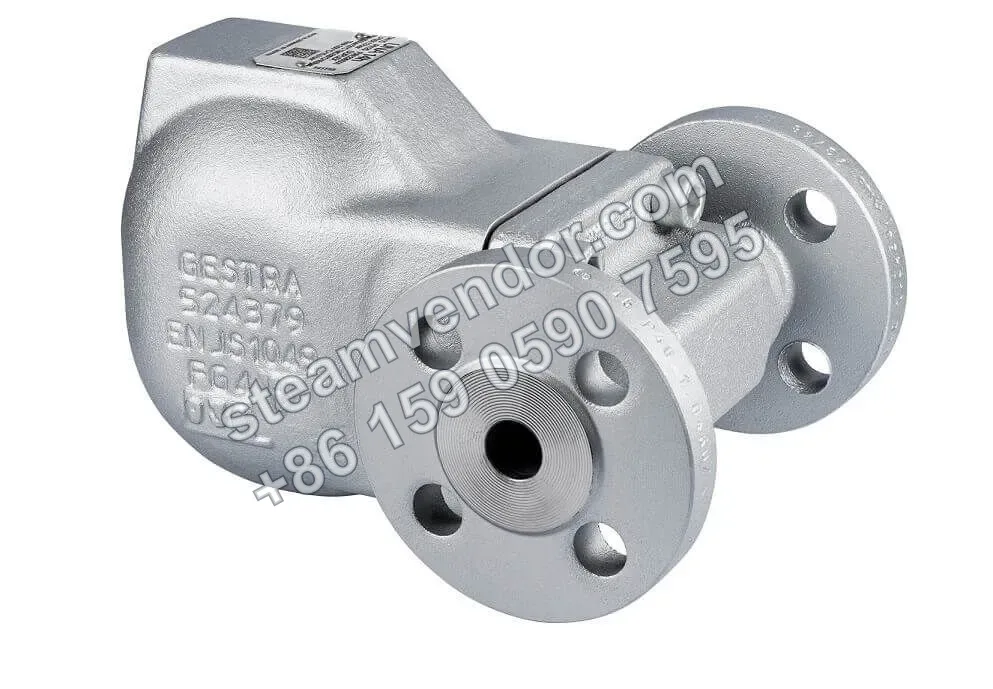
Gestra UNA16 is a float-type steam trap specifically designed for steam and condensate systems and featuring a rolling ball valve design. The product has a carbon steel body and supports multiple connection types, including flanged, threaded, and welded connections. It is available with Simplex, Simplex R, or Duplex control units, allowing conversion between horizontal and vertical pipeline installation by repositioning the valve body and control unit. It is suitable for steam system pipelines and provides continuous condensate discharge for industrial applications with different pressure ratings and nominal sizes.
Product image of Gestra ball float steam trap UNA16, three-quarter view
1 / 1
UNA16 Ball Float Steam Trap | Gestra
Ball float steam trap with rolling ball valve, convertible for horizontal or vertical installation, with multiple connection options.
Genuine product assurance
We can help verify product data and purchasing details.
Model confirmation
Confirm model, connection and key options before ordering.
After-sales support
After-sales communication support is provided according to the order agreement.
Specifications
- Steam trap type
- Ball-float steam trap with a rolling ball valve
- Applicable media
- Steam and condensate
- Control unit
- Simplex, Simplex R, or Duplex
- Automatic air venting
- Simplex R: continuous air venting; Duplex: automatic air venting with a GESTRA 5N2 thermostatic capsule, temperature-dependent type
- Installation orientation
- Type h for horizontal pipelines; type v for vertical pipelines; convertible by repositioning the valve body and control unit
- Nominal size
- DN15, DN20, DN25
- Connection types
- DIN EN 1092-1 PN40 flanges, ASME Class 150 flanges, BSP/NPT threaded sockets, socket-weld ends, butt-weld ends
- Pressure-temperature ratings
- DIN EN 1092-1 PN40: PMA 40 bar (-10/20°C), 30.2 bar (200°C), 25.8 bar (300°C), 23.1 bar (400°C); ASME Class 150: PMA 17.3 bar (-29/20°C), 13.8 bar (200°C), 10.2 bar (300°C), 6.5 bar (400°C)
- Maximum differential pressure
- 4, 13, or 22 bar, depending on the orifice size
- Orifice size
- A0 4 (orifice diameter 4.8 mm), A0 13 (orifice diameter 3.3 mm), A0 22 (orifice diameter 2.8 mm)
- Body material
- Carbon steel 1.0460 (P250GH; ASTM A105)
- Seat sealing material
- Graphite/CrNi
Application scenarios
Condensate discharge in steam systems
Used in pipelines in steam and condensate systems for continuous condensate discharge. The product features a ball-float design, supports horizontal or vertical pipeline installation, and can be equipped with Simplex, Simplex R, or Duplex control units.
Installation & maintenance notes
Match the installation orientation to the pipeline configuration
The h-type UNA16 is intended for horizontal pipelines, while the v-type is intended for vertical pipelines. If the installation orientation needs to be changed, the valve body and control unit can be repositioned for conversion.
FAQ
How does the UNA16 ball float steam trap work?
The UNA16 uses a ball float and a valve seat seal to separate steam from condensate and discharge surplus condensate while preventing steam loss. The float opens and closes the valve in response to changes in water level, providing self-adjusting drainage across varying operating conditions.
Which installation options does the UNA16 support?
The UNA16 supports DIN/ANSI flanges, threaded sockets, NPT threads, socket-weld ends and butt-weld ends, allowing the appropriate connection form to be selected for horizontal or vertical pipework.
How do I size the model to ensure suitable differential pressure and flow capacity?
Match the maximum allowable differential pressure and discharge capacity to the DN, PN, connection type, and the pressure and temperature range of the steam system in question.
What are the main materials and sealing construction of the UNA16?
The body is steel (1.0460) and the valve seat seal is graphite/CrNi; the stainless steel version UNA16A is made from stainless steel. The gaskets are graphite-CrNi, the float is a stainless steel alloy, and the seals and other components use corrosion-resistant materials.
For maintenance, does replacing the control unit require removing the valve body?
No. The control unit can be replaced without removing the body from the line; access is gained simply by removing the cover, and the body and control unit can be repositioned to convert the model (e.g. between horizontal and vertical versions).