

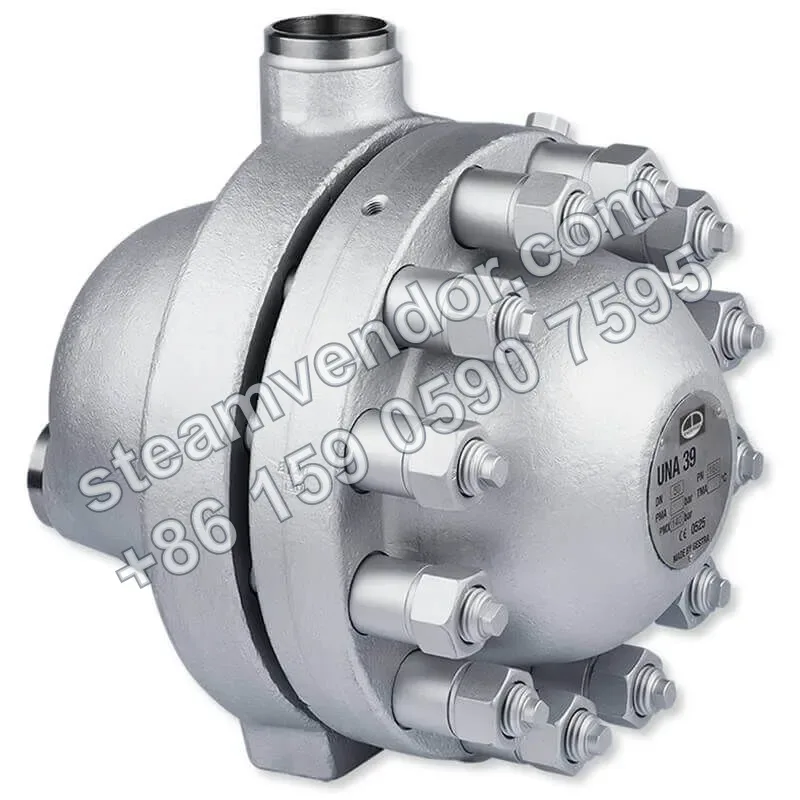
The Gestra UNA39 is a high-pressure ball float and needle-valve angle-type steam trap designed for high-pressure steam systems. It features a heat-resistant 13CrMo4-5 structural steel body and stainless steel internal components, with pressure ratings up to PN 160 or ASME Class 900/1500 and a pressure capacity of 37.3 barg at 550°C. It is equipped with a SIMPLEX float control unit with a manual air venting valve and is available with flanged, socket-weld, and butt-weld end connections. The product is primarily used for condensate drainage at drain points in high-pressure main steam networks.
Three-quarter product photo of the Gestra UNA39 high-pressure steam trap
1 / 1
UNA39 Ball Float and Needle-Valve Steam Trap
Ball float and needle-valve angle-type steam trap for condensate drainage from high-pressure main steam networks, supporting multiple end connections.
Genuine product assurance
We can help verify product data and purchasing details.
Model confirmation
Confirm model, connection and key options before ordering.
After-sales support
After-sales communication support is provided according to the order agreement.
Specifications
- Steam trap type
- Ball float and needle-valve type
- Body connection configuration
- Angle type
- Nominal diameter
- DN15, DN25, DN40, DN50
- Pressure rating
- PN 160; ASME Class 900/1500
- Pressure-temperature rating
- 160 barg (-10 to 300°C); 134.8 barg (450°C); 104.3 barg (500°C); 71.6 barg (520°C); 46.4 barg (540°C); 37.3 barg (550°C)
- Maximum allowable differential pressure
- 80 bar (orifice 80); 110 bar (orifice 110); 140 bar (orifice 140/140 MAX)
- Control unit
- SIMPLEX float control unit with manual air venting valve
- Orifice sizes
- Orifice 80, 110, 140, 140 MAX
- Connection types
- DIN/ANSI flanges, socket-weld ends, butt-weld ends
- Flange standards
- EN 1092-1 B2 PN 160; ASME B16.5 CL 900 RF
- Socket-weld standards
- DIN EN 12760; ASME B16.11 CL 6000
- Butt-weld end standards
- EN 12627; weld joints comply with ISO 9692-1, code 1.3 (30° bevel)
- Body material
- Structural steel 13CrMo4-5 (EN 1.7335; ASTM A182-F12)
- Internal component material
- Stainless steel
- Body gasket material
- Graphite/CrNi
Application scenarios
Drainage of high-pressure main steam networks
Used to discharge condensate from drain points in high-pressure steam networks. The product is a ball float and needle-valve steam trap supporting the PN 160 pressure rating and offering flanged, socket-weld, and butt-weld connections for installation in corresponding high-pressure steam systems.
Installation & maintenance notes
Limit the maximum allowable differential pressure of the control unit
During operation, limit the actual differential pressure across the steam trap to the specified maximum allowable differential pressure for the selected orifice size: no more than 80 bar for orifice 80, no more than 110 bar for orifice 110, and no more than 140 bar for orifice 140 and 140 MAX.
FAQ
How does the Gestra UNA39 ball float and needle-valve steam trap discharge condensate from high-pressure steam networks?
The UNA39 uses a liquid-level-dependent SIMPLEX float control unit. When condensate enters the valve body, it actuates the float and opens the discharge passage through the ball valve. For the 140 MAX orifice control unit, the float controls the pressure in the control chamber through a pilot valve. Once the control-chamber pressure decreases, the main valve opens to discharge condensate. The orifice cross-sectional area determines the maximum flow rate when the passage is fully open. This type of ball float and needle-valve design is not affected by back pressure.
Which high-pressure steam applications are suitable for the UNA39, and how are the pressure and temperature limits confirmed?
The UNA39 is primarily used at condensate drainage points in high-pressure main steam networks. For PN 160 or Class 1500 end connections, the maximum allowable pressure is 160 barg at temperatures from -10 to 300°C. The allowable pressure decreases as the temperature rises: 134.8 barg at 450°C, 104.3 barg at 500°C, 71.6 barg at 520°C, 46.4 barg at 540°C, and 37.3 barg at 550°C. The pressure-temperature ratings for Class 900 flange connections differ from those for PN 160/Class 1500. Selection must therefore be verified against the actual end connection, operating temperature, and pressure-temperature rating.
How should the 80, 110, 140, or 140 MAX orifice control unit be selected for the Gestra UNA39?
The UNA39 is available with 80, 110, 140, and 140 MAX orifices. The maximum allowable differential pressures for the 80, 110, and 140 orifices are 80 bar, 110 bar, and 140 bar, respectively. The 140 MAX is a SIMPLEX control unit designed for high-flow-rate, high-pressure applications, with a maximum allowable differential pressure of 140 bar. Orifice selection must match both the system differential pressure and the required condensate discharge capacity. The discharge capacity is also affected by the inlet-to-outlet differential pressure, condensate density, and downstream piping configuration.
Which piping connection types and sizes are available for the UNA39?
The UNA39 has an angle-pattern valve body and is available with EN 1092-1 B2 PN 160 flanges, ASME B16.5 Class 900 RF flanges, DIN EN 12760 socket-weld ends, ASME B16.11 Class 6000 socket-weld ends, and butt-weld ends compliant with EN 12627. The butt-weld ends feature a 30° bevel in accordance with ISO 9692-1 code 1.3. Nominal sizes include DN15, DN25, DN40, and DN50.
What venting and maintenance-related configurations are provided with the UNA39 SIMPLEX control unit?
The UNA39 is equipped with a SIMPLEX float control unit and includes a manual air-vent valve. The valve body is made of 13CrMo4-5 structural steel, the internal components are stainless steel, and the valve-body gasket is made of graphite/CrNi. For maintenance replacement, the control units are differentiated by orifice size: 80, 110, 140, and 140 MAX. Corresponding spare-parts configurations are also available for the valve-body gasket, manual air-vent valve, and gasket kits.