

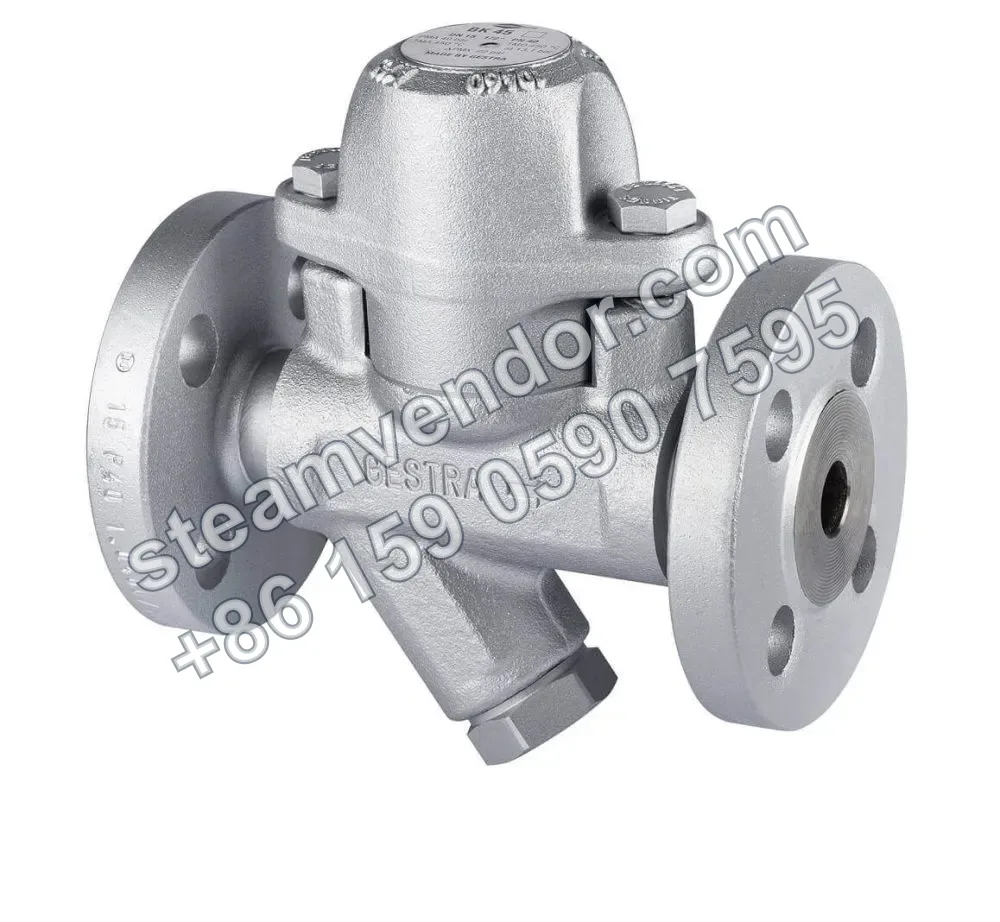
The Gestra BK45 is a steam trap based on the bimetallic operating principle, designed to provide efficient thermodynamic air venting and condensate drainage for steam systems. It features a carbon steel 1.0460/A105 valve body and a stainless steel regulator, with nominal pressure ratings covering PN40 and Class 150/300. Multiple connection options are available, including flanged, threaded, and welded connections. The trap automatically discharges non-condensable gases during system start-up and operation, making it particularly suitable for automatic thermodynamic air venting processes in steam systems.
Product photo of the Gestra BK45 bimetallic steam trap, double-flange version
1 / 1
BK45 Bimetallic Steam Trap | Gestra
Bimetallic-controlled steam trap for thermal venting during startup and operation of steam systems, available with flanged, threaded, butt-weld and socket-weld connections.
Genuine product assurance
We can help verify product data and purchasing details.
Model confirmation
Confirm model, connection and key options before ordering.
After-sales support
After-sales communication support is provided according to the order agreement.
Specifications
- Operating principle
- Bimetallic Duo regulator; temperature increase drives the staged nozzle toward closure
- Air venting function
- Automatic air venting during start-up and operation; suitable for thermodynamic air venting in steam systems
- Regulator subcooling
- Standard version: Δt approximately 15 K
- Maximum permissible differential pressure
- 22 bar
- Pressure-temperature ratings
- PN40 flanges: 40.0 bar g at 20°C, 13.1 bar g at 450°C; Class 150 flanges: 19.6 bar g at -29/38°C, 5.5 bar g at 425°C; Class 300 flanges, butt-weld ends, socket-weld ends, and threaded sockets: 51.1 bar g at -29/38°C, 28.8 bar g at 425°C
- Nominal pressure classes
- PN 40; ASME Class 150; ASME Class 300
- Connection types
- DIN/ANSI flanges, G-threaded sockets, NPT-threaded sockets, socket-weld ends, butt-weld ends
- Connection sizes
- DN15, DN20, DN25 (½″, ¾″, 1″)
- Flange standards
- EN 1092-1 PN40; ASME B16.5 Class 150/Class 300
- Butt-weld end standards
- EN 12627; ASME B16.25
- Socket-weld end standards
- EN 12760; ASME B16.11 Class 3000
- Thread standards
- ISO 228-1 (G/BSP); ASME B16.11 (NPT)
- Valve body and bonnet materials
- Steel 1.0460; ASME material A105
- Regulator material
- Stainless steel
- Sealing materials
- Graphite/CrNi
Application scenarios
Thermodynamic air venting during steam system start-up and operation
Suitable for automatic thermodynamic air venting during steam system start-up and operation. As the temperature increases, the bimetallic regulator drives the staged nozzle toward closure, enabling air venting control in response to temperature changes.
Installation & maintenance notes
Maximum permissible differential pressure limit
During commissioning and operation, the actual operating differential pressure must not exceed the BK45 maximum permissible differential pressure of 22 bar.
FAQ
What is the working principle of the BK45, and how does it discharge condensate in a steam system?
The BK45 uses a bimetallic regulator with a stepped orifice design. During startup, the trap opens fully to discharge condensate and air. As the temperature rises, the bimetallic discs bend and progressively close the orifice until it shuts completely just below saturation temperature. The thermodynamic action at the orifice promotes fast, stable condensate discharge, ensuring automatic venting of the system during both startup and operation.
Which end connections are available for the BK45, and how should it be selected for different flange standards?
The BK45 supports DIN/ANSI flanges, threaded connections, NPT threads, socket-weld ends and butt-weld ends. Selection should be based on the piping standard and pressure rating used on site (e.g. PN40, Class 150/300), confirming the matching end connection type and its corresponding pressure/temperature limits.
What are the maximum allowable pressure and temperature of the BK45?
For the BK45 family, the maximum allowable pressure with PN40 flanges varies by size; under typical PN40 conditions, PMA for DN15-DN25 is approximately 40 barg, with temperatures ranging from 20°C to 450°C. For welded and socket-weld ends and other flange ratings, PMA, TMA and ΔPmx are determined by the specific model and end connection.
What are the key technical differences between the BK45-LT and the BK46?
The BK45-LT uses a SA350 LF2 body material and is intended for applications requiring low-temperature capability, while the BK46 is made of 1.5415 stainless steel, offering different strength and corrosion-resistance characteristics. Both are steam traps within the BK45 series and share the same core operating principle; they differ in materials, end connection options and their specific temperature/pressure limits.