

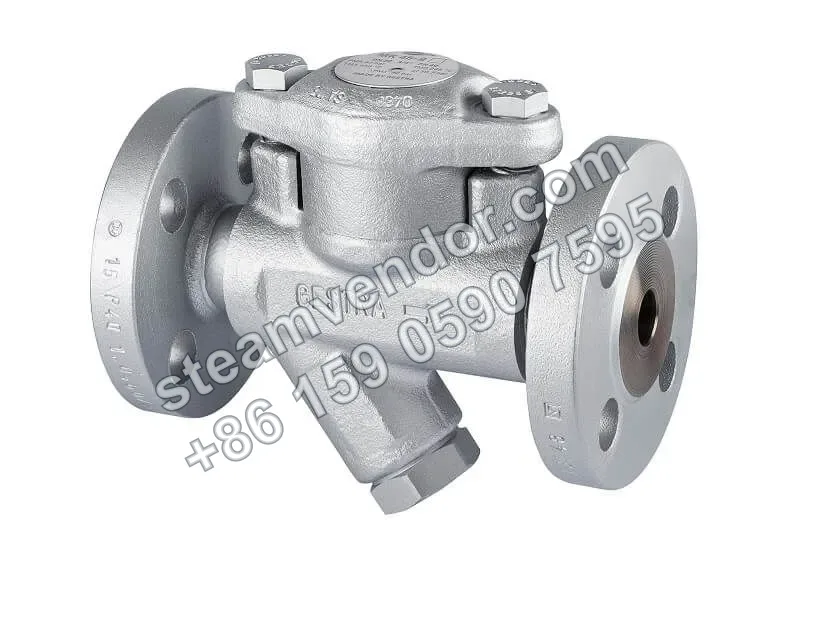
Gestra MK45A is a thermostatic steam trap equipped with a corrosion-resistant Hastelloy® diaphragm regulator and an all-stainless-steel body. The product is available in DN15 to DN25 sizes and supports various connection types, including flanged, threaded, and welded connections. It also features an integrated Y-strainer and check function. It is suitable for condensate drainage in steam lines and can be deployed in corresponding high-temperature, high-pressure steam systems according to its pressure-temperature ratings.
Gestra MK45A bimetallic steam trap double-flange product image
1 / 1
MK45A Bimetallic Steam Trap | Gestra
All-stainless-steel thermostatic steam trap with integrated Y-type strainer and check valve, DN15-DN25.
Genuine product assurance
We can help verify product data and purchasing details.
Model confirmation
Confirm model, connection and key options before ordering.
After-sales support
After-sales communication support is provided according to the order agreement.
Specifications
- Steam trap type
- Thermostatic steam trap with corrosion-resistant diaphragm regulator
- Applicable media
- Steam and condensate; allowable operating temperature is the saturated steam temperature
- Nominal size
- DN15, DN20, DN25 (1/2", 3/4", 1")
- Connection types
- EN 1092-1 PN40 flanges, ASME B16.5 Class 150/300 RF flanges, G threads, NPT threads, socket-weld ends, and butt-weld ends connected via transition pieces
- Thread standards
- G thread: ISO 228-1; NPT thread: ASME B16.11
- Weld-end standards
- Socket weld: DIN EN 12760 or ASME B16.11 Class 3000; butt weld: EN 12627/ISO 9692-1 or ASME B16.25/ASME B36.10
- Body material
- Stainless steel 1.4404 (ASME A182 F316L)
- Sealing material
- Graphite/CrNi
- Diaphragm regulator material
- Hastelloy®
- Maximum allowable differential pressure
- PN40, Class 300, threaded and welded ends: 32 bar (465 psi); Class 150 flanges: 15.9 bar (284 psi)
- Pressure-temperature ratings
- PN40 flanges: 40 barg (-10/20°C), 27.6 barg (300°C), 25.7 barg (400°C); Class 150 flanges: 15.9 barg (-29/38°C), 10 barg (300°C), 6.5 barg (400°C); Class 300, threaded and welded ends: 41.4 barg (-10/38°C), 26.1 barg (300°C), 24.3 barg (400°C)
- High-temperature operating limit
- Intergranular corrosion may occur at operating temperatures above 300°C; operation above 300°C is not permitted unless the risk of intergranular corrosion can be ruled out
- Condensate subcooling
- Standard capsule N: approximately 10 K; capsule U: approximately 30 K; capsule H: approximately 5 K
- Valve seat configuration
- Tandem double valve seats for low condensate flow rates; single valve seat for higher condensate flow rates
- Integrated functions
- Integrated Y-strainer and check function
- Pressure equipment compliance
- Compliant with the Pressure Equipment Directive (PED), for Group 2 fluids
Application scenarios
Condensate drainage in steam lines
Used for condensate drainage in steam lines, with a thermostatic diaphragm regulator and integrated Y-strainer and check function. The product is suitable for steam and condensate media, available in DN15 to DN25 sizes with flanged, threaded, and welded-end connections, and can be used in corresponding high-temperature, high-pressure steam systems according to its pressure-temperature ratings.
Installation & maintenance notes
High-temperature operating limitation
Intergranular corrosion may occur at operating temperatures above 300°C. Operation above 300°C is not permitted unless the risk of intergranular corrosion can be ruled out.
FAQ
Which steam systems is the Gestra MK45A steam trap suitable for?
The Gestra MK45A is used to discharge condensate from steam lines. The applicable media are steam and condensate, and the operating temperature should correspond to the saturated steam temperature. The valve uses a thermostatic membrane regulator and discharges condensate once it has cooled to the specified subcooling level. An integral Y-strainer and check function make the valve suitable for steam-trapping points where both contaminant retention and prevention of reverse flow are required. When selecting the configuration, the valve cloud warehouse can assist procurement personnel in considering line pressure, temperature, condensate load, and connection standards.
How should the membrane capsule subcooling of MK45A be selected?
MK45A is available with three membrane capsules: the standard N capsule discharges condensate at a temperature approximately 10 K below the boiling temperature, the U capsule at approximately 30 K below, and the H capsule at approximately 5 K below. The H capsule may be considered when a lower subcooling level is required so that condensate is discharged closer to the saturation temperature. The U capsule may be considered when greater utilization of condensate sensible heat is desired and a larger subcooling level is acceptable. The N capsule provides a standard subcooling level of approximately 10 K. During selection, it must also be confirmed that the control capsule will not be exposed to superheated conditions exceeding 5°C.
What are the differences between MK45A-1 and MK45A-2 in terms of seat design and applicable flow rate?
MK45A-1 uses a tandem dual-seat design with double sealing and is particularly suitable for low condensate flow rates. MK45A-2 uses a single-seat design and is suitable for higher condensate flow rates. For engineering selection, first determine the seat type according to the actual condensate load, then verify the required discharge capacity against the corresponding capacity curve based on the selected capsule subcooling level.
What sizes and connection types are available for the Gestra MK45A?
MK45A is available in DN15, DN20, and DN25, corresponding to 1/2 inch, 3/4 inch, and 1 inch sizes. Connection options include EN 1092-1 PN40 flanges, ASME B16.5 Class 150 or Class 300 RF flanges, ISO 228-1 G threads, ASME B16.11 NPT threads, DIN EN 12760 or ASME B16.11 Class 3000 socket-weld ends, and butt-weld ends connected via transition fittings. The valve cloud warehouse recommends verifying the pipe nominal size, existing connection standard, and pressure rating during procurement to avoid connection mismatches.
How should the pressure-temperature rating of MK45A be verified under high-temperature, high-pressure conditions?
The allowable pressure of MK45A varies with the end connection type and temperature. For PN40 flanges, the allowable pressure is 27.6 barg at 300°C and 25.7 barg at 400°C. For Class 150 flanges, it is 10 barg at 300°C and 6.5 barg at 400°C. For Class 300 flanges, threaded ends, and welded ends, it is 26.1 barg at 300°C and 24.3 barg at 400°C. The maximum allowable differential pressure is 32 bar for PN40, Class 300, threaded, and welded ends, and 15.9 bar for Class 150 flanges. Particular attention should be paid to the risk of intergranular corrosion at operating temperatures above 300°C. Unless this risk can be ruled out, the valve should not be used at temperatures above 300°C.