

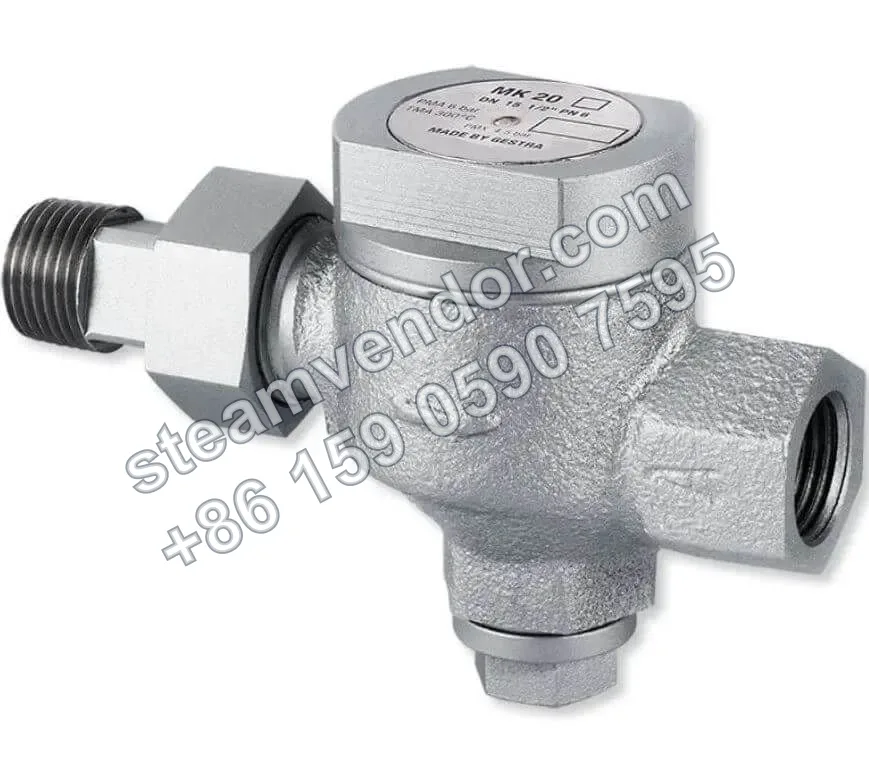
Gestra MK20 is a thermostatic membrane steam trap. It features a malleable cast iron valve body and a Hastelloy® membrane, supports installation in any position, and is available in straight-through or angle configurations with multiple threaded connections. It has a maximum operating pressure of 4.5 barg at 250°C and is unaffected by upstream pressure fluctuations or back pressure during operation. The product is primarily used for condensate drainage in low-pressure steam heating systems and provides automatic air venting during start-up and continuous operation.
Product photo of Gestra MK20 membrane steam trap, 3/8" and 1/2" angle pattern
1 / 1
MK20 Thermostatic Membrane Steam Trap | Gestra
Thermostatic membrane steam trap with straight-through or angle threaded connections, suitable for installation in any position.
Genuine product assurance
We can help verify product data and purchasing details.
Model confirmation
Confirm model, connection and key options before ordering.
After-sales support
After-sales communication support is provided according to the order agreement.
Specifications
- Steam trap type
- Thermostatic membrane steam trap
- Maximum operating pressure
- 4.5 barg (65 psig) at 250°C (482°F); 3.6 barg (52 psig) at 300°C (572°F)
- Maximum differential pressure
- 4.5 bar (65 psi)
- Maximum hot condensate capacity
- 1000 kg/h at a 3 bar differential pressure
- Maximum cold condensate capacity
- 1700 kg/h at a 3 bar differential pressure
- Connection type
- Male-threaded union connection at the inlet, female-threaded connection at the outlet
- Thread sizes
- 1/2 in and 3/4 in BSP
- Valve body configuration
- Straight-through or angle
- Installation orientation
- Suitable for installation in any position
- Valve body material
- GTW-40 malleable cast iron (0.8040)
- Membrane material
- Hastelloy®
- Internal component material
- Stainless steel
- Air venting function
- Automatic air venting during start-up and continuous operation
- Back-pressure tolerance
- Operation is unaffected by upstream pressure fluctuations or back pressure
- Standard thermostatic element
- 5 U 2 subcooling element
Application scenarios
Condensate drainage in low-pressure steam heating systems
The steam trap is particularly suitable for low-pressure steam heating equipment. It automatically discharges condensate generated during operation, with a maximum operating pressure of 4.5 barg within the applicable pressure range.
Automatic air venting during steam system start-up and continuous operation
This thermostatic membrane steam trap automatically vents air during steam system start-up and continuous operation, controlling opening and closing according to the temperature and pressure inside the steam trap.
Flexible installation in different piping configurations
The steam trap supports installation in any position and is available with a straight-through or angle valve body to accommodate different piping configurations.
Steam trapping in systems subject to pressure fluctuations and back pressure
The steam trap operates independently of upstream pressure fluctuations or back pressure and can operate with a maximum differential pressure of 4.5 bar, making it suitable for condensate drainage in steam systems subject to pressure fluctuations or back pressure.
Installation & maintenance notes
Verify the connection configuration
Before installation, verify that the valve body connection configuration matches the site piping. The inlet uses a male-threaded union connection, while the outlet uses a female-threaded connection. Ensure compatibility to prevent leakage.
Confirm pressure, temperature, and differential pressure limits
Before installation and commissioning, confirm that the actual operating pressure, temperature, and differential pressure are within the permissible range for MK20. The maximum operating pressure is 4.5 barg at 250°C and 3.6 barg at 300°C, with a maximum differential pressure of 4.5 bar.
Inspect and replace the thermostatic diaphragm element
During maintenance and servicing, inspect the condition of the thermostatic element with a Hastelloy diaphragm and replace it when necessary. The element is secured inside the valve body with a snap-fit design for convenient removal and replacement.
FAQ
How does the MK20 work, and how does it discharge condensate in a steam system?
The MK20 uses a thermostatic element controlled by a membrane regulator. By monitoring the temperature and pressure inside the valve, it opens and closes automatically to discharge condensate from the steam system, ensuring high-capacity drainage that rapidly removes accumulated water while remaining unaffected by upstream pressure fluctuations.
What pressure and temperature ranges is the MK20 rated for?
The maximum operating pressure is 4.5 barg (65 psig) at temperatures up to 250°C (482°F). The alternative rating is 3.6 barg (52 psig) at temperatures up to 300°C (572°F). The maximum differential pressure is 4.5 bar (65 psi).
What are the design features of the MK20, and what are the key installation points?
The body is available in straight-through or angle pattern design, and the core components are the body and the thermostatic element with a Hastelloy® membrane. The shell is held by a snap-fit fastening for easy removal. The inlet is a male-threaded union nut, the outlet is female-threaded, and the thread standards are 1/2 and 3/4 BSP. The trap can be installed in any position.
How does the MK20 perform during startup and normal operation?
During startup, the trap provides a high discharge capacity to remove cold condensate; during operation, it rapidly discharges hot condensate as required. The discharge capacity varies with the differential pressure and the pipe routing. If the condensate must be lifted downstream, the differential pressure drops by approximately 1 bar for every 7 m of lift. Actual values must be taken from the capacity curves for the specific operating conditions.