

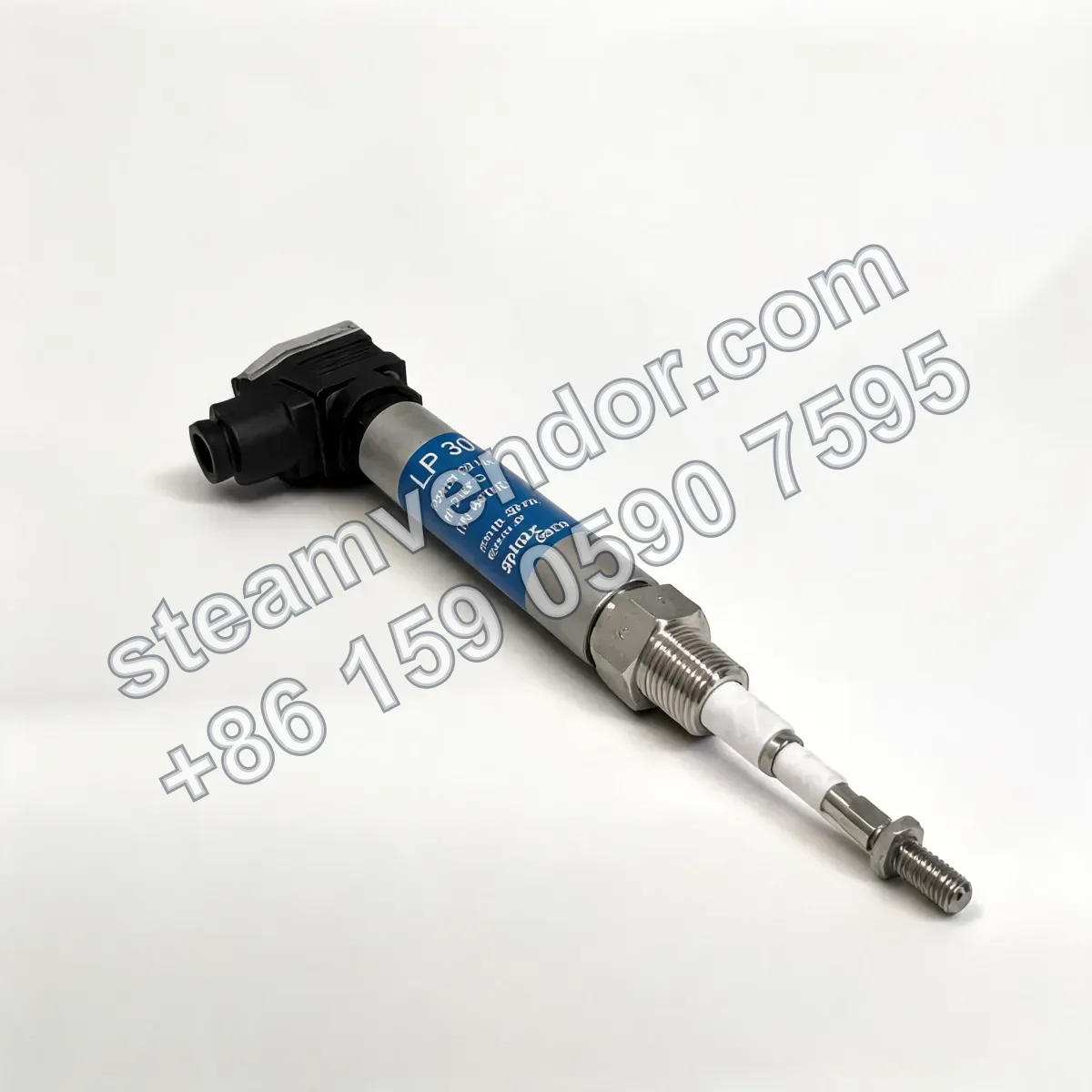
The Spirax Sarco LP30 is a level sensor for self-monitoring low level alarming of steam boilers, and must be used with the LC3050 level controller. The product uses a 1/2" BSP internal thread connection, is suitable for operating conditions up to 32 bar g and 239 °C, and provides probe lengths of 500, 1000, and 1500 mm. The comparison probe can compensate for ground resistance leakage caused by scaling, impurities, or water droplets, supporting boiler low level state identification.
LP30 product photo
1 / 1
Spirax Sarco LP30 Steam Boiler Self-Monitoring Level Sensor
Self-monitoring level sensor, for steam boiler low water level alarm, supports 500 to 1500 mm probes
Genuine product assurance
We can help verify product data and purchasing details.
Model confirmation
Confirm model, connection and key options before ordering.
After-sales support
After-sales communication support is provided according to the order agreement.
Specifications
- Design pressure rating
- PN40
- Maximum working pressure
- 32 bar g (239 °C)
- Cold hydrostatic test pressure
- 60 bar g
- Maximum ambient temperature
- 70 °C
- Maximum sensor wire length
- 50 m
- Protection rating
- IP65
- Installation connection
- 1/2" BSP internal thread connection
- Probe length
- 500 mm, 1000 mm, 1500 mm
- Minimum clearance between probe and protection tube
- 14 mm
- Sensor body material
- Austenitic stainless steel BS EN 10088-3 (1.4306)
- Outer layer material
- Austenitic stainless steel Type 316L
- Probe material
- Austenitic stainless steel Type 316L
- Comparison probe material
- Austenitic stainless steel Type 316L
- Insulator material
- PTFE BS 6564 Grade UA Type 1
Application scenarios
Steam boiler self-monitoring low level alarm
The LP30, used with the Spirax Sarco LC3050 level controller, is for high-precision self-monitoring low level alarming of steam boilers. When the boiler water level drops below the sensor probe, the resistance to ground increases, and the controller issues a low level alarm signal.
Boiler low level monitoring under boiler water scaling or impurity-containing conditions
For steam boilers with harsh internal conditions such as scale, impurities, or internal water droplets. The comparison probe can compensate for ground resistance leakage caused by these factors, to support correct identification of low level alarm states.
FAQ
How does the low level alarm of the LP30 self-monitoring level sensor work?
The LP30 must be used with the LC3050 level controller. Under normal conditions, the probe is partially immersed in water with low resistance to ground; when the water level drops below the probe, the resistance to ground increases, and the controller issues a low water level alarm signal. The comparison probe can compensate for the effect of ground resistance leakage caused by scale, impurities, or internal water droplets.
What operating conditions is the LP30 suitable for?
The LP30 is used for self-monitoring low level alarming of steam boilers, with a maximum boiler pressure of 32 bar g, maximum temperature of 239 °C, and maximum ambient temperature of 70 °C. The specific configuration must be confirmed according to the actual model and application conditions.
What probe lengths are available for the LP30?
The LP30 is available in three probe lengths: 500 mm, 1000 mm, and 1500 mm. The specific configuration must be confirmed according to the actual model and application conditions.
What are the key requirements during installation of the LP30?
The LP30 is designed for use with the LC3050 controller. Steam boilers are usually installed with two sensors and controllers, respectively implementing a first low alarm and a second low alarm. The installation connection is a 1/2-inch BSP internal thread; when installed in a boiler or a water tank with strong turbulence, a protection tube must be used. The probe must not contact any part of the boiler, and the clearance from the protection tube must be at least 14 mm.
Does the LP30 require maintenance and periodic inspection?
The LP30 requires no special maintenance, but the boiler water level alarm control system requires periodic testing and inspection.