

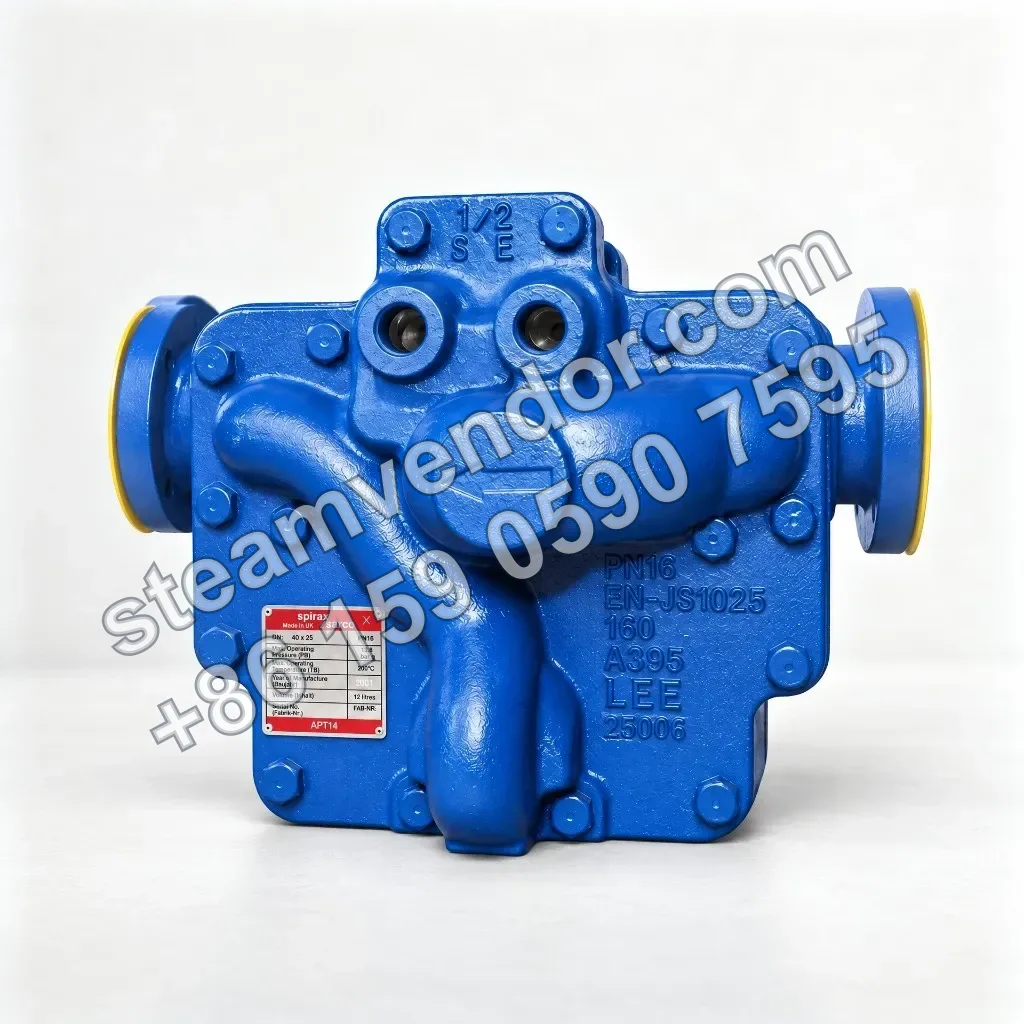
Spirax Sarco APT14, APT14HC, and APT14SHC are steam-powered automatic pump-traps requiring no electricity. The series is available with ductile iron or carbon steel bodies and is designed for pressure ratings up to PN16. It automatically switches between steam-trap and pumping cycles according to line pressure. With flanged or threaded connections, it is designed for process equipment subject to pressure fluctuations, including steam heating and vacuum applications, providing automatic condensate drainage and recovery under conditions of insufficient differential pressure.
Spirax Sarco Automatic Pump Trap APT14 Front View Product Photo
1 / 1
APT14, APT14HC, APT14SHC Steam-Powered Automatic Pump-Traps | Spirax Sarco
Steam-powered automatic pump-traps requiring no electricity, suitable for condensate discharge under fluctuating pressure and vacuum conditions.
Select model
Genuine product assurance
We can help verify product data and purchasing details.
Model confirmation
Confirm model, connection and key options before ordering.
After-sales support
After-sales communication support is provided according to the order agreement.
Specifications
- Driving medium
- Steam
- Power supply requirement
- No electrical power required
- Operating mode
- Automatically switches between steam trap cycling and pump cycling according to line pressure
- Suitability for vacuum conditions
- Removes condensate from process equipment under vacuum conditions
- Body design pressure rating
- PN16
- Maximum motive steam inlet pressure
- 13.8 barg
- Maximum operating pressure
- 13.8 barg @ 198°C
- Maximum allowable pressure
- 16 barg @ 120°C (APT14, APT14HC)
- Maximum allowable temperature
- 300°C @ 12.8 barg (APT14, APT14HC)
- Maximum operating temperature
- 198°C @ 13.8 barg
- Minimum operating temperature
- -10°C
- Maximum backpressure
- 5 barg
- Hydraulic test pressure
- 24 barg
- Pump displacement
- APT14: 5 litres/cycle; APT14HC, APT14SHC: 8 litres/cycle
- Maximum steam trap mode capacity
- APT14: 4000 kg/h; APT14HC, APT14SHC: 9000 kg/h (1 m installation height, 5 barg motive steam)
- Maximum pump mode capacity
- APT14: 1100 kg/h; APT14HC, APT14SHC: 2800 kg/h (1 m installation height, 5 barg motive steam, 1 barg backpressure)
- Connection type
- Flanged or threaded connections
- Inlet and outlet sizes
- APT14: DN40 inlet × DN25 outlet or 1 1/2″ inlet × 1″ outlet; APT14HC, APT14SHC: DN50 inlet × DN40 outlet
- Flange standards
- EN 1092 PN16, ANSI 150 B16.5, JIS 10 (JIS B 2210), or KS 10 (KS B 1511)
- Body material
- APT14, APT14HC: ductile iron EN JS 1025 or ASTM A395; APT14SHC: carbon steel EN 1.0619+N or ASTM A216 WCB
Application scenarios
Condensate removal from steam process equipment under fluctuating pressure conditions
For condensate drainage from steam-heated process equipment. When the equipment-side pressure can overcome the downstream pressure, the unit drains through steam trap cycling. When the differential pressure is insufficient, it automatically switches to steam-powered pump cycling to discharge the condensate.
Condensate removal from process equipment under vacuum conditions
For condensate drainage from process equipment operating under vacuum conditions. This series uses steam as the driving medium and requires no electrical power, allowing condensate to be discharged from process equipment through pump cycling under vacuum conditions.
Steam-powered condensate drainage where no electrical power is available
For condensate drainage systems serving process equipment where motive steam is available but electrical power is not required for operation. The unit is steam-powered and automatically switches between steam trap cycling and pump cycling according to line pressure.
Selection points
Steam-powered operation with no electrical power required
APT14, APT14HC and APT14SHC all operate using steam as the driving medium and require no external electrical power.
Automatic changeover between steam trap and pump modes
This series automatically switches between steam trap cycling and pump cycling according to line pressure.
Suitable for condensate drainage under vacuum conditions
This series removes condensate from process equipment under vacuum conditions.
Standard and high-capacity configurations
APT14 has a pump displacement of 5 litres per cycle, a maximum steam trap mode capacity of 4000 kg/h, and a maximum pump mode capacity of 1100 kg/h. APT14HC and APT14SHC have a pump displacement of 8 litres per cycle, a maximum steam trap mode capacity of 9000 kg/h, and a maximum pump mode capacity of 2800 kg/h. Steam trap mode data is based on a 1 m installation height and 5 barg motive steam; pump mode data also includes 1 barg backpressure.
Ductile iron and carbon steel body configurations
APT14 and APT14HC use ductile iron bodies, while APT14SHC uses a carbon steel body.
Inlet and outlet sizes with multiple flange standards
APT14 is available with a DN40 inlet and DN25 outlet or a 1 1/2 inch inlet and 1 inch outlet. APT14HC and APT14SHC have a DN50 inlet and DN40 outlet. Available flange standards include EN 1092 PN16, ANSI 150 B16.5, JIS 10, and KS 10.
Installation & maintenance notes
Control the motive steam inlet pressure
During commissioning and operation, confirm that the motive steam inlet pressure does not exceed 13.8 barg and remains within the product's allowable pressure range to prevent overpressure or abnormal cycling.
Check capacity against the installation height
When installing the unit, check the required capacity against the actual installation height. The listed maximum steam trap mode and pump mode capacities are both based on a 1 m installation height.
Isolate, depressurize and cool before maintenance
Before maintenance or dismantling, isolate the motive steam and associated process pipework. Confirm that the equipment and connected pipework have been depressurized and adequately cooled to prevent burns caused by escaping steam or hot condensate.
FAQ
How does the APT14 series automatic pump trap work?
The unit is steam-powered and automatically switches between steam trap cycling and pump cycling according to line pressure to discharge condensate from process equipment. It is suitable for operating conditions including vacuum conditions.
How should APT14, APT14HC and APT14SHC be compared for selection?
The models differ in body material and inlet/outlet size combinations. APT14 uses ductile iron and is available with DN40 × DN25 flanged or threaded connections. APT14HC provides the larger DN50 × DN40 inlet/outlet size combination, with material suitability for different operating conditions. APT14SHC uses carbon steel and has an outlet connection configuration similar to the other two models. The specific model should be confirmed against the actual application conditions.
What connection types are available, and how should the appropriate connection be selected?
The equipment is available with flanged or threaded connections. Flange selection should be based on standards such as EN 1092 PN16 and ANSI 150, together with the corresponding inlet and outlet sizes. Threaded connections are available with interfaces such as BSP/NPT. The appropriate connection should be selected according to the site pipework standards and dimensions.
Which certifications and certificates can be used for compliance confirmation during procurement?
The equipment is designed in accordance with the European Pressure Equipment Directive 97/23/EC and the ATEX Directive 94/9/EC. An EN 10204 3.1 certificate can be supplied upon request.
What installation and operating conditions are required to ensure the correct capacity and performance during selection?
Provide the installation height, motive steam pressure, backpressure in the condensate return line, operating pressure of the heat exchanger at full load, steam load of the heat exchanger, minimum inlet temperature of the heated medium, and maximum controlled temperature. The specific capacity and configuration should be determined according to the actual installation conditions.