

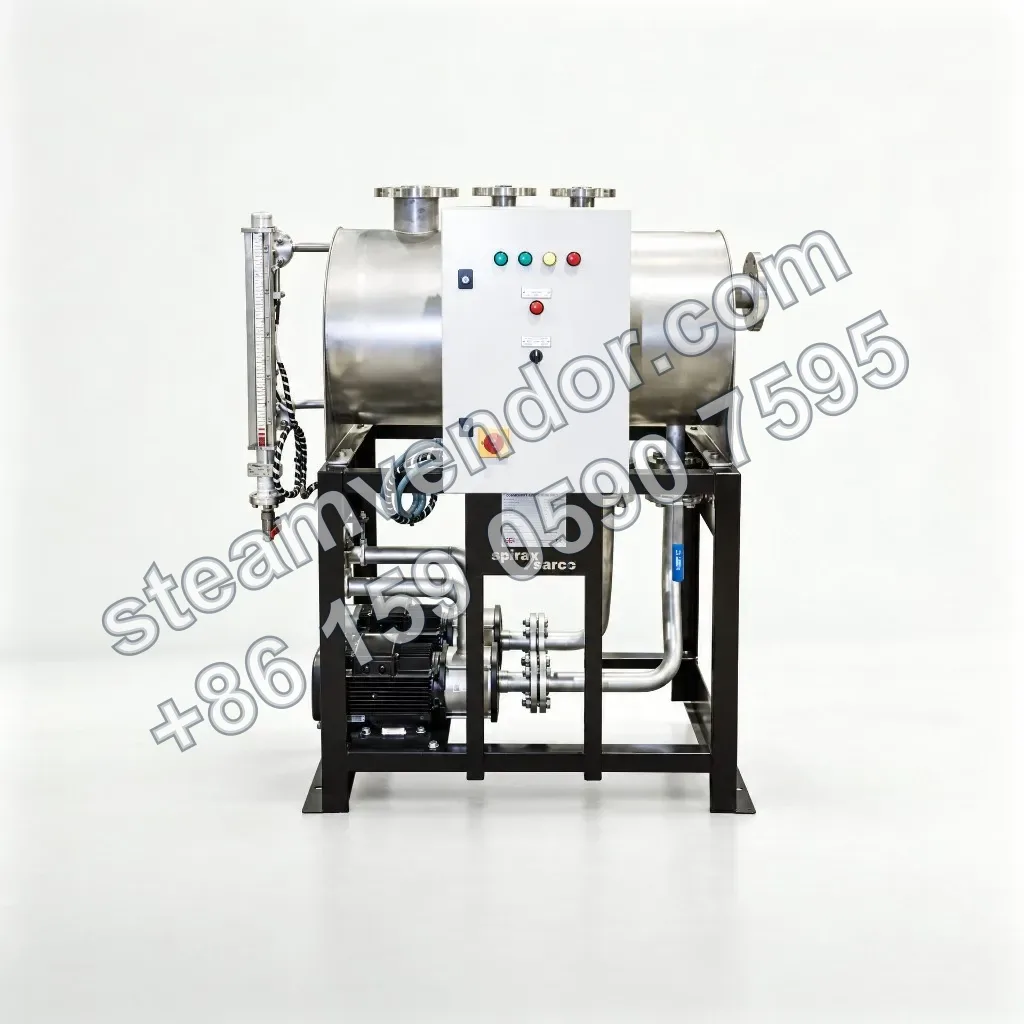
The Spirax Sarco E Series condensate recovery unit is an industrial high-temperature condensate lifting system with PN16 flanged connections. It features dual-pump cascaded operation and PLC touchscreen control, and is designed for applications with extremely low NPSH requirements. At 98°C and a 50 m head, it provides a maximum condensate handling capacity of 60 t/h. The unit is suitable for transferring hot condensate to boiler feedwater systems, combined waste steam recovery, and condensate recovery stations requiring remote centralised control.
Spirax Sarco Condensate Recovery Unit E Series Front View Product Photo
1 / 1
E Series Condensate Recovery Unit | Spirax Sarco
Dual-pump cascaded condensate lifting equipment for boiler feedwater transfer and combined waste steam recovery.
Genuine product assurance
We can help verify product data and purchasing details.
Model confirmation
Confirm model, connection and key options before ordering.
After-sales support
After-sales communication support is provided according to the order agreement.
Specifications
- Maximum Condensate Handling Capacity
- 60 t/h (at a medium temperature of 98°C and a pump head of 50 m)
- Applicable Medium
- Hot condensate; optional waste steam recovery function
- Pump Set Configuration
- Two-pump cascade operation with automatic failure changeover
- Control Method
- PLC control with touchscreen, supporting remote control and scheduled start/stop
- Connection Type
- PN16 flanged connection; other connection types available on request
- Tank Material
- Carbon steel; stainless steel optional
- Tank Internal Surface Corrosion Protection
- Optional hot-dip galvanizing
- Pump Body Material
- Cast iron
- Pump Suction Conditions
- Suitable for extremely low NPSH conditions and capable of handling boiling condensate at minimum suction head
- Motor Insulation Class
- Class F
- Ingress Protection Rating
- IP55
- Level Measurement Method
- Magnetic level gauge
Application scenarios
Recovery and Transfer of Hot Condensate for Boiler Feedwater
Used to centrally recover hot condensate returned from steam-using equipment and pressurize it for transfer to the boiler feedwater system. At a medium temperature of 98°C and a pump head of 50 m, the maximum condensate handling capacity can reach 60 t/h.
Elevated Recovery of High-Temperature Condensate at Low Suction Head
Used for the centralized recovery and elevated transfer of hot condensate. The pump set is suitable for extremely low NPSH conditions and can handle boiling condensate at minimum suction head, making it suitable for layouts where the recovery point requires elevated transfer.
Combined Recovery of Waste Steam and Hot Condensate
Used in projects involving the simultaneous recovery and utilization of hot condensate and waste steam. The unit can be configured with a waste steam recovery function to meet related recovery requirements.
Centrally Managed Condensate Recovery Station with Remote Control
Used in applications requiring centralized management of the operating status of condensate recovery units. The unit uses PLC control and a touchscreen, and supports remote control and scheduled start/stop.
Selection points
Suitability for Boiling Condensate under Extremely Low NPSH Conditions
The unit is suitable for extremely low NPSH conditions and can handle boiling condensate at minimum suction head.
Two-Pump Cascade Operation with Automatic Failure Changeover
The unit uses two-pump cascade operation. When the duty pump is insufficient to meet the load, the other pump starts, with automatic failure changeover also provided.
PLC and Touchscreen Control
The unit uses PLC control and is equipped with a touchscreen, supporting remote control and scheduled start/stop.
Carbon Steel or Stainless Steel Tank with Optional Internal Surface Corrosion Protection
The tank and connection components are made of carbon steel, with stainless steel available as an option. Hot-dip galvanizing is optionally available for the tank internal surface.
PN16 Flanged Connection
The unit uses PN16 flanged connections. Other connection types can also be supplied according to customer requirements.
Installation & maintenance notes
Medium and Operating Condition Limitations
The unit should be used with hot condensate. The waste steam recovery function is only applicable to units with the optional configuration and must be operated within the operating conditions specified for the product. Use beyond the applicable medium and design conditions may result in equipment damage or corrosion.
FAQ
How does the E Series Condensate Recovery Unit work?
This series recovers hot condensate through a tank, two pumps operating in parallel, and a PLC control system. The pump set operates in coordination according to the load demand to process and recover the condensate.
How are the appropriate pump head and capacity model determined?
Model selection follows the selection instructions: determine the model at the intersection of the horizontal line representing the condensate flow rate to be handled and the straight line representing the pump head. For special requirements, please specify them when placing the order. The detailed configuration must be confirmed according to the actual model and application conditions.
What connection sizes and material options are available for the unit?
The standard connection is a PN16 flange. The tank and connection components are made of carbon steel, with stainless steel also available. Connection sizes and the AA, BB, CC, DD, EE, FF, and anchor-bolt parameters for different models are listed in the table.
What are the main features of the control system?
The pumps are controlled by a PLC and support advanced functions such as remote control and scheduled start/stop, with a touchscreen interface provided. The two pumps operate in cascade, automatically adapting to load changes and performing automatic changeover in the event of a failure to extend pump service life.
What are the key maintenance points for the tank and pumps?
The tank is equipped with an inspection opening, drain, overflow, and magnetic level gauge. Each pump has an independent suction pipe, isolation valve, filter, and vibration isolator. System pressure head and noise must be inspected during maintenance, and the relevant valves adjusted as necessary. Insulation is not included as standard. Specific maintenance procedures must be carried out according to the actual system conditions.