

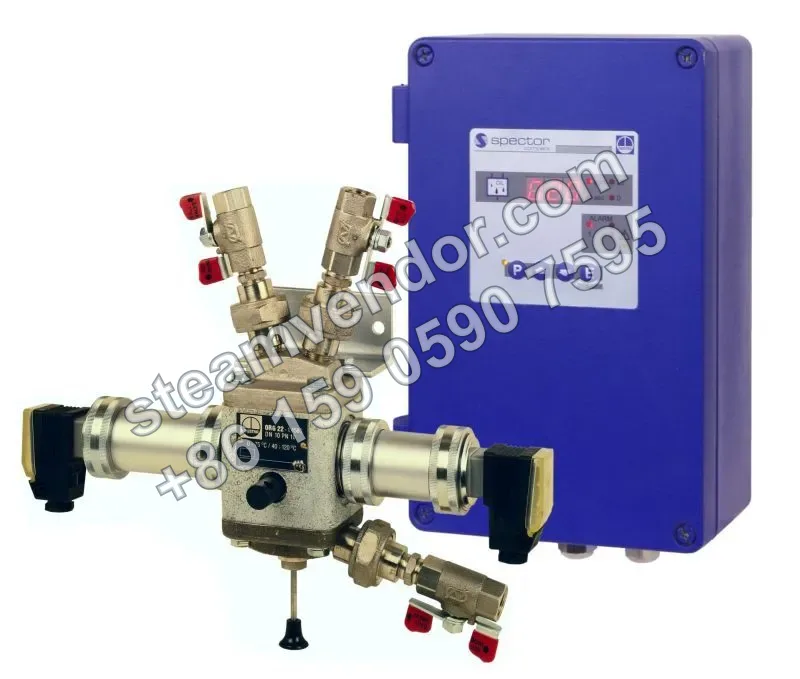
Gestra OR52/5 and OR52/6 are part of the TURBISCOPE oil and turbidity detector series. Based on the 15° forward-scattering light principle, they provide online monitoring of 0–25 ppm oil and insoluble matter in transparent liquids. The ORT 6 transmitter provides a 4–20 mA output and two alarm channels. OR52/5 is equipped with an ORG 12 grey cast iron sensor for conventional boiler condensate and industrial water treatment. OR52/6 is equipped with an ORG 22 stainless steel sensor for pure water, food and beverage applications, and pharmaceutical process water.
Gestra oil and turbidity detector OR52/5 (ORG 12 grey cast iron sensor) product image
1 / 1
OR52/5 OR52/6 Oil and Turbidity Detectors | Gestra
TURBISCOPE series in-line oil and turbidity monitor based on the 15° forward light-scattering principle, with ORT 6 transmitter providing 4-20 mA output and dual alarms.
Select model
Genuine product assurance
We can help verify product data and purchasing details.
Model confirmation
Confirm model, connection and key options before ordering.
After-sales support
After-sales communication support is provided according to the order agreement.
Models
OR52/5 and OR52/6 share the ORT 6 measuring transmitter and the 15° forward-scattering light measurement principle. They differ in sensor material and suitability for corrosive media. OR52/5 is equipped with an ORG 12 grey cast iron sensor for conventional boiler condensate, industrial feedwater, and sand filter monitoring. OR52/6 is equipped with an ORG 22 stainless steel sensor for pure water, RO/DI permeate, food and beverage applications, and pharmaceutical process water.
OR52/5Grey cast iron sensor version (ORG 12)
OR52/5 is equipped with an ORG 12 grey cast iron (GG-25) measuring sensor and an ORT 6 transmitter for conventional industrial boiler condensate recovery, feedwater monitoring, and multimedia or sand filter monitoring. This model provides the best cost efficiency where the condensate is neutral, non-corrosive, and the medium is not food grade.
OR52/6Stainless steel sensor version (ORG 22)
OR52/6 is equipped with an ORG 22 stainless steel measuring sensor and an ORT 6 transmitter for high-purity condensate from high-pressure boilers, RO/DI pure water sections, food and beverage brewing, pharmaceutical WFI, and specialty chemical applications requiring corrosion resistance and high hygiene standards. It prevents sensor corrosion and secondary contamination in high-temperature deionized water or pure water service.
Specifications
- Measurement principle
- 15° forward-scattering light measurement
- Measuring range
- 0–25 ppm
- Alarm setting range
- 0–15 ppm (Alarm 1 and Alarm 2)
- Alarm delay range
- 0–20 s
- Flow rate range
- 0.5–50 l/min
- Operating pressure
- PN 10; 10 bar at a maximum temperature of 120°C
- Fluid temperature range
- 0–60°C (with drying cartridge); 60–120°C (with vent connection)
- Maximum medium pH
- 10.5
- Mechanical connection
- DN 10, G 3/8 A thread, ISO 228
- Sensor pressure drop
- 5 mbar
- Protection rating
- Sensor IP65; ORT 6 measuring transmitter IP65 (EN 60529)
- Current output
- 4–20 mA, maximum load 500 ohm
- Alarm output
- 3 volt-free changeover contacts (Alarm 1, Alarm 2, fault), maximum 4 A
- Supply voltage
- 230 V +10/–15%, 50–60 Hz; 115 V or 24 V optional
- Power consumption
- 25 VA
- Maximum cable length from sensor to transmitter
- 50 m
- OR52/5 sensor material
- ORG 12 grey cast iron GG-25
- OR52/6 sensor material
- ORG 22 stainless steel (cover 1.4580, threaded connection 1.4571)
- Type approval
- TÜV · WÜL · XX-009, compliant with VdTÜV Water Quality Monitoring 100
- UL/cUL certification
- UL 508, CSA C22.2 No. 14-13, file E243189
Application scenarios
Steam boiler rooms and condensate recovery systems
For monitoring condensate circuits and feedwater in steam boiler rooms and detecting oil ingress caused by heat exchanger leakage. OR52/5 with an ORG 12 grey cast iron sensor is suitable for conventional industrial boiler rooms and provides the best cost efficiency when recovered condensate is neutral and non-corrosive. OR52/6 with an ORG 22 stainless steel sensor is suitable for high-pressure boilers and ultra-pure condensate systems. High-temperature deionized water or pure water can be highly corrosive to iron materials, requiring a fully stainless steel sensor to prevent instrument corrosion and secondary contamination.
Water treatment and pure water production systems
Used as a water quality safeguard to monitor oil contamination upstream of multimedia sand filters, reverse osmosis (RO), and deionization (DI) systems. OR52/5 can be selected for ordinary industrial raw water and sand filter monitoring. After the process enters the reverse osmosis permeate or deionized water section, OR52/6 should be selected because the medium has high purity and strong corrosivity.
Food, beverage, and brewing industries
For wort monitoring, beer and beverage filtration and clarification control, flavor and aroma quality control, and process wastewater monitoring. These industries have strict hygiene and acid and alkali resistant CIP cleaning requirements, so only the stainless steel OR52/6 is permitted. The grey cast iron OR52/5 must not contact any food or beverage medium.
Pharmaceutical and specialty chemical industries
For purity monitoring of process water and water for injection (WFI) systems, as well as leakage monitoring for reactor jacket cooling water and heating water. Due to chemical compatibility and GMP contamination-control requirements, these applications generally use the stainless steel OR52/6.
Selection points
Select OR52/5 or OR52/6 according to wetted material requirements
OR52/5 is equipped with an ORG 12 grey cast iron sensor for conventional condensate, industrial feedwater, and sand filter monitoring. OR52/6 is equipped with an ORG 22 stainless steel sensor for pure water, food and beverage applications, pharmaceutical process water, and CIP cleaning conditions.
Select the sensor according to system purity and corrosivity
OR52/5 is preferred for neutral industrial condensate and water treatment at ambient temperature. OR52/6 should be selected for deionized water, RO permeate, WFI, and high-temperature high-purity condensate to prevent grey cast iron corrosion and secondary contamination of the medium under low-mineral-content water conditions.
Stainless steel version mandatory for food and pharmaceutical applications
For any monitoring point that contacts food, beverages, brewing liquids, or pharmaceutical process water, only OR52/6 may be selected. The OR52/5 grey cast iron sensor must not be used.
FAQ
What is the key difference between OR52/5 and OR52/6?
Both models use the ORT 6 measuring transmitter and the 15° forward-scattering light measurement principle. The key difference is the sensor material. OR52/5 uses an ORG 12 grey cast iron (GG-25) sensor for conventional industrial condensate, feedwater, and sand filter monitoring. OR52/6 uses an ORG 22 stainless steel sensor for pure water, deionized water, food and beverage applications, and pharmaceutical process water requiring higher corrosion resistance.
How does the oil and turbidity detector work?
The measuring sensor consists of a light source and a light receiver. A continuous light beam passes through the transparent liquid, and particles of insoluble matter generate scattered light. The 15° forward-scattering light principle converts this into an electrical signal. The ORT 6 measuring transmitter performs signal analysis, displays the measured value, and indicates Alarm 1, Alarm 2, and fault status.
What are the main measuring and alarm parameters?
The standard measuring range is 0–25 ppm, with the 4–20 mA current output corresponding to 0–25 ppm. The Alarm 1 and Alarm 2 limits can be adjusted within 0–15 ppm, and the alarm delay can be set from 0–20 s. The flow rate range is 0.5–50 l/min, and the operating pressure is PN 10, corresponding to 10 bar at a maximum temperature of 120°C.
Which applications require OR52/6?
In food, beverage, and brewing industries, as well as pharmaceutical and specialty chemical applications, OR52/6 with an ORG 22 stainless steel sensor should be selected wherever the unit contacts media intended for human use, water for injection (WFI), process water, or media requiring resistance to acid and alkali CIP cleaning. The grey cast iron OR52/5 must not be used in contact with food-grade or high-purity media.
How should alarms or abnormal conditions be handled?
Alarm 1 and Alarm 2 provide two alarm contacts for graded pre-alarm and main alarm control. In condensate monitoring, Alarm 1 can actuate a three-way valve to discharge contaminated condensate, while Alarm 2 triggers the main alarm. The alarm contacts do not automatically switch in the event of a fault; the fault status must be integrated into the interlock according to the wiring diagram. Specific limits and interlock logic should be configured according to the site operating conditions.